Six follow-up journeys for patients responding to clinic ads
An enquiry from an ad enters the right journey and receives a text message and email in under a minute, with no manual data entry.
4 min read
- Client
- Dental clinic
- Industry
- Healthcare / Automation
- Scope
- AI sales agents & lead generation
- Delivery time
- 7 days
Who the client was and what was getting in the way
A dental clinic ran Facebook ad campaigns that generated dozens of enquiries a day. The problem was that these enquiries were very different. One person asked about implants, another about braces, someone else about whitening, and another simply wanted a check-up. Everyone received exactly the same message because no one had time to segment enquiries manually. A person considering an implant, a service that involves a much bigger decision, got a generic reply and stopped responding.
Speed was another issue. Responding to a new enquiry took two to four hours because someone had to open the dashboard, copy the details, and send an email and a text message. By then, a competitor might already have called. In healthcare services, the first clinic to make contact often wins, and those two hours cost the clinic real appointments.
Third, there was silence after the first message. No follow-up sequences existed, so anyone who did not reply right away was lost. Finally, the team had no way to tell who was genuinely interested. They called everyone in turn, with no prioritisation because they had nothing to base it on.
What we built
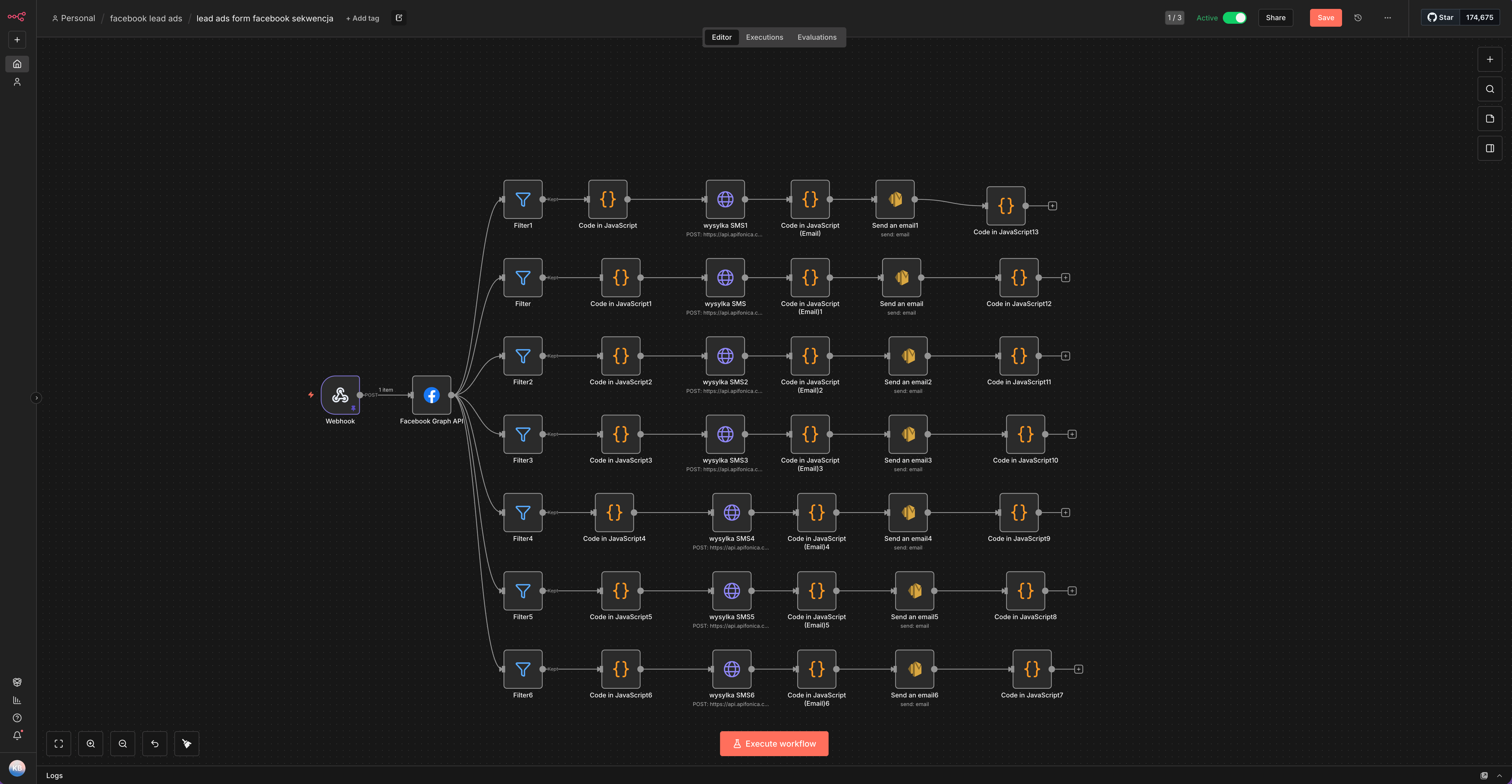
The system runs on n8n. Enquiries arrive through a webhook from the Facebook Graph API, so they enter the workflow as soon as someone submits a form, rather than when a morning export is processed.
At the start, the workflow routes enquiries into six journeys based on the stated interest, including implants, orthodontics, whitening and routine check-ups, plus a separate path for other cases. Each journey has its own content and timing because a conversation about implants differs from booking a check-up.
Each branch has its own JavaScript logic for validating phone numbers, normalising form data, enriching it with information from public sources and scoring the enquiry based on its source and how completely the form was filled out. That score then determines the callback queue.
Follow-up uses two channels. Immediately after an enquiry, the patient receives a welcome text, followed by an email with details about the service they asked about. A reminder follows after two days, then a final prompt to book an appointment. Every message is tailored to the selected journey.
Finally, the workflow adds the enquiry to the customer-management system with tags, a status and a score. The strongest prospects are routed directly to a designated team member with an alert, while colder leads enter a longer sequence and can be picked up later.
How it works today
A patient submits a form in an ad and, in under a minute, receives a text and email tailored to the service they asked about. Their details are already in the system with a tag and score, so the team opens a list in the morning ordered by likelihood to convert instead of calling people at random. Anyone who does not reply right away receives the next messages in their journey, and some come back after a few days.
We built this in seven days. The first two were spent mapping the services and designing the journeys; the next three on the workflow and email and text integrations; and the final two on connecting the customer-management system, testing every journey, comparing message subject lines and training the team.
What changed
Six separate follow-up journeys are running, one for each service type. Responses are immediate: email and text messages go out less than a minute after an enquiry. Enquiry scores are calculated automatically and determine the callback queue. Manual enquiry handling has fallen to zero; the entire path from form to customer-management system runs without a person.
What we would do differently
Starting with six journeys was two too many. Two had so little traffic that we could not test anything meaningfully, while maintaining content for each took the same effort. Next time, we will start with the three strongest journeys and split them further only when the data supports it. Our second lesson concerns form data quality. Phone numbers arrived in several formats, and some text messages simply failed until we added validation. That should have been the workflow’s first node, not a fix added midway through.
Related projects
How a consulting firm got a weekly list of companies showing fresh buying signals
Instead of manually checking the press and public registers, the sales team starts Monday with a ready-made list of companies, each lead scored and assigned an owner.
A database of German HVAC installers built from scratch for export sales
More than 580 verified German B2B companies, delivered in batches within a few days, with email addresses, registry details, and a fit score.



